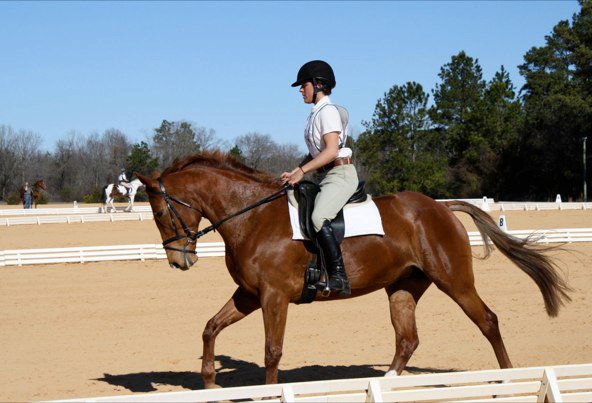
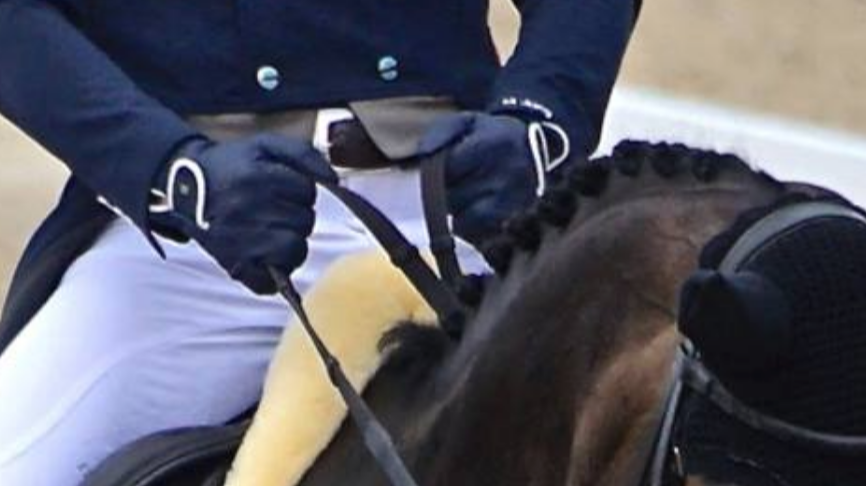
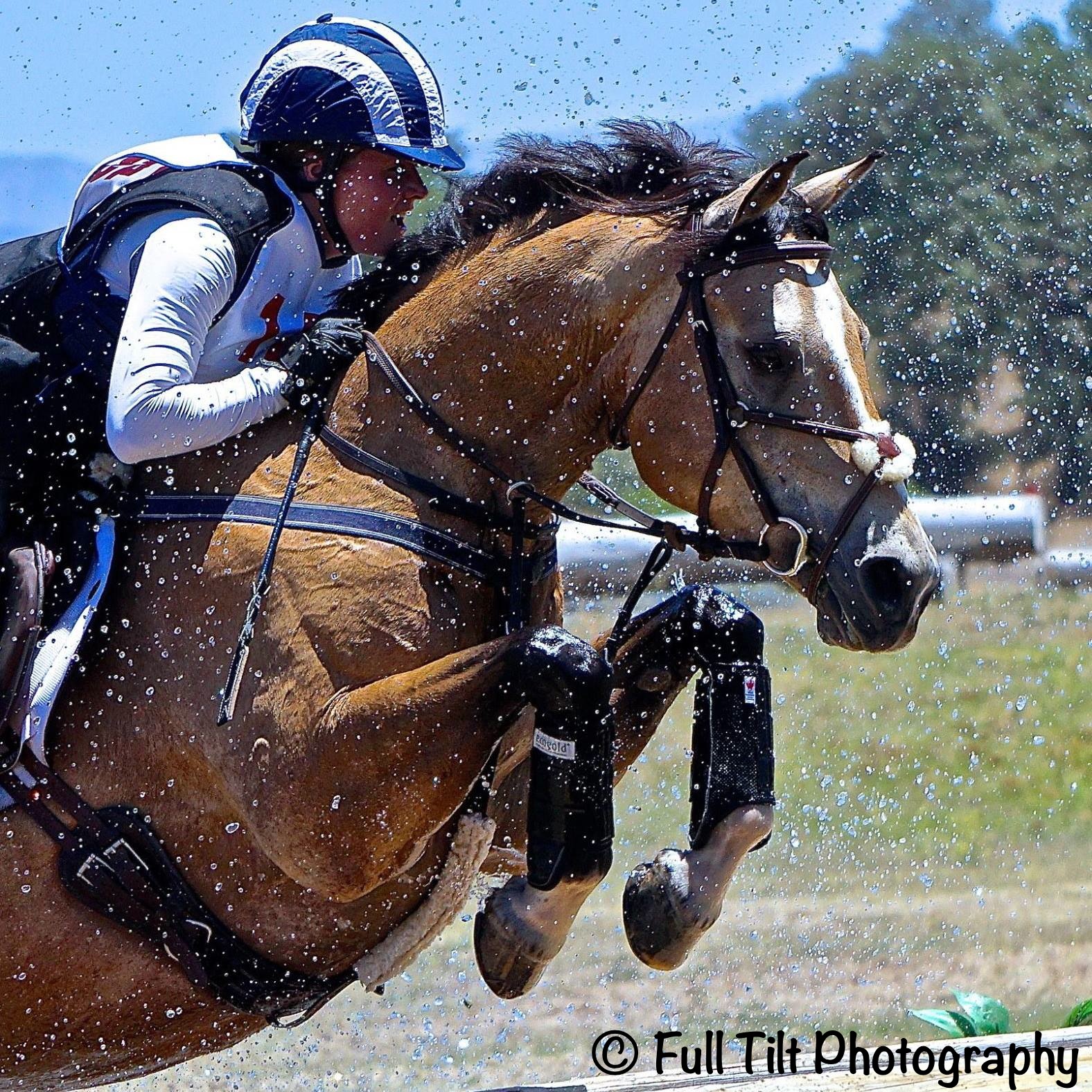
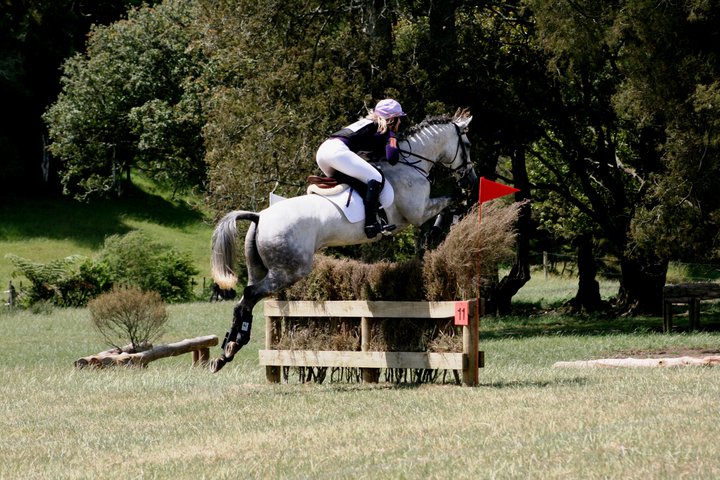
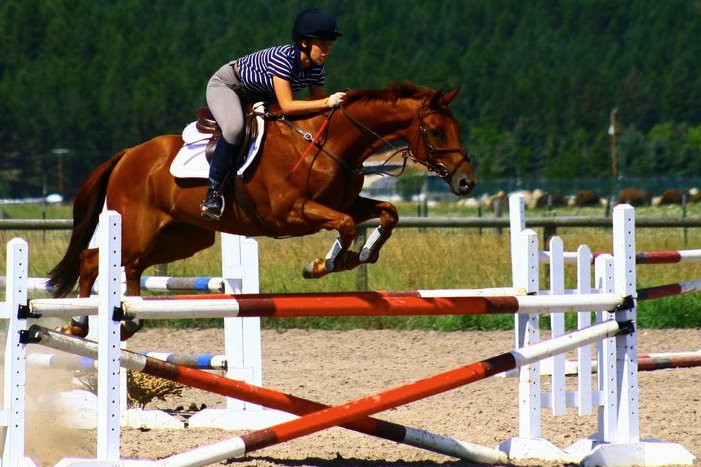
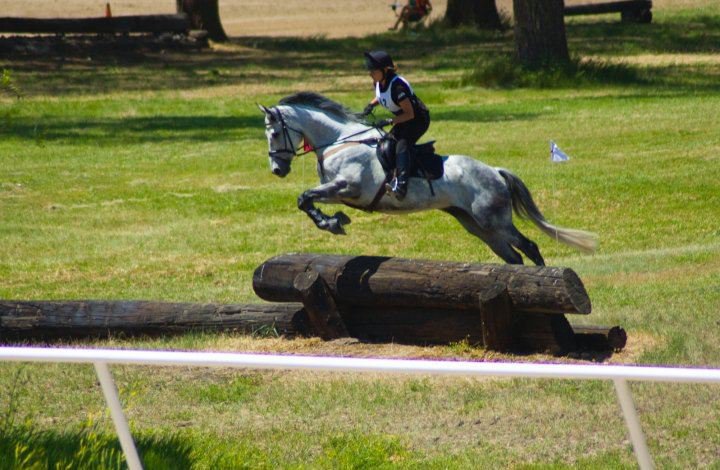
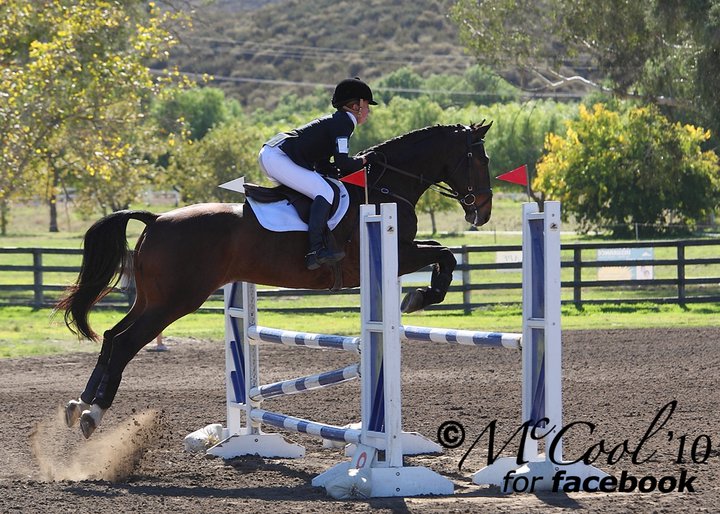
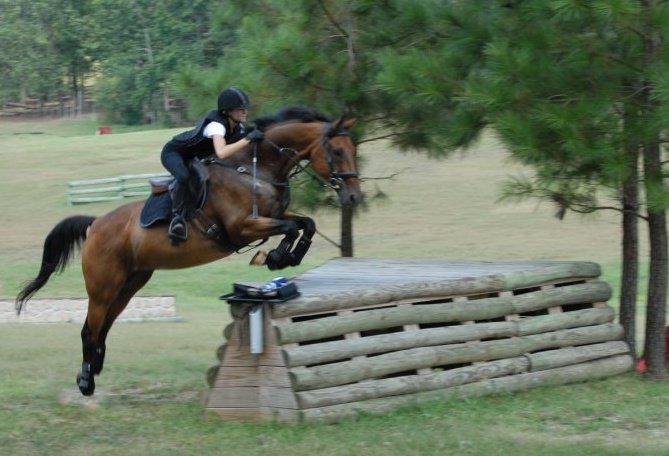
All horses are sensitive enough to feel a fly land on their sides. So when you put your leg on to ask your horse to go forward, he definitely feels your aid. What he does with it depends on his rider. If you want your horse to fully respect your leg aid and go forward immediately every time you apply it, you have to decide to accept nothing less when you are riding. You have to change your expectations, and be ready to provide the appropriate feedback immediately. It's that simple. Here's what to do: (Click on Article Title above (in blue) to read full article)
(just stuff cotton in there? does it stay?) When would you put studs on all four feet? Is it ok to only drill the back shoes? (to reduce cost). Thanks! (Briana)
Hi Briana!
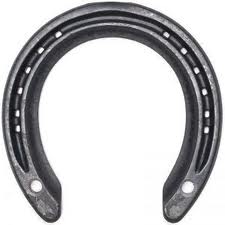
Your farrier should know where to put the stud holes. He will either use a machine, or will have to drill and tap them by hand. They are usually an inch or so from the heels of the shoe like this:
Here is a very important tip! (Click on Question Title above (in blue) to read full answer)
Ahh, an adrenaline junkie! I know the type very well. I could probably help you a whole lot more if you send me a video so I can see how you are handling the situation when he gets strong. Can you do that?
I'm getting self conscious that I should be farther along. Always been under the belief that until a horse or rider is bored at a level, don't move up. (Kimberly)
Hi Kimberly!
My opinion is that horse and rider don't necessarily need to be bored at their current level to move up, but.....(Click on Question Title above (in blue) to read full answer)Photo # 10: This is Kimberly!
(Click on Photo Title above (in blue) to read full critique)
Let's discuss how the average rider can benefit by adding Virtual Coaching to their current training program. It should be used as a supplement, to enhance and deepen your understanding of the concepts you are learning in your program with your own trainer.
Say you are currently working on... (Click on Article Title above (in blue) to read full article)
Some horses are born with an innate natural ability to lengthen the trot. And some need to develop the ability through training. Those without the natural tendency to lengthen usually simply quicken their trot when asked for a lengthening. This is because they don't naturally bring their hocks underneath their bodies enough to "coil the spring" of the hind legs. It's the energy created from the coiling of the spring of the hind legs that propels the horse into that lovely lengthening that everyone loves to watch!
Here are some exercises that will help the horse with less natural ability learn how to lengthen the trot rather than quicken: (Click on Article Title above to read full article)
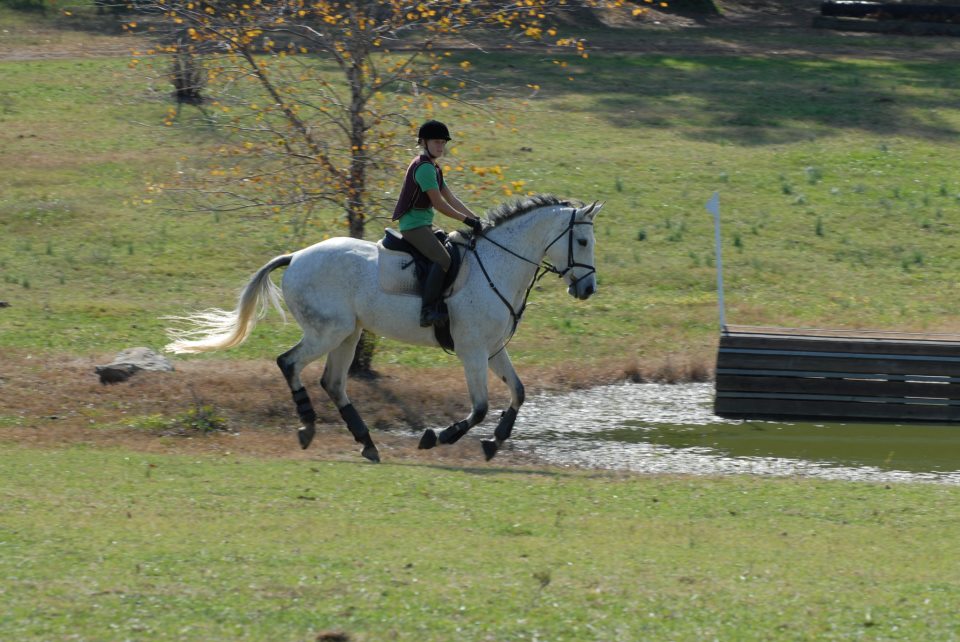
Cross country riders must have this seat in their repertoire. It becomes increasingly important as one moves up the levels, as the speed and jump dimensions increase... (Click on Article Title above (in blue) to read full article)
A supple horse is a joy to ride. Free from the paralyzing effects of tension and resistance, the truly supple horse allows the energy created by the hindquarters to move freely into the connection with the bit.
There are two components of suppleness in a horse....(Click on Article Title above to read full article)
Question #15: At what level do I need to start using studs? (Andi)
This is a great question Andi! And you will find a lot of different opinions on this subject. There are some who feel that the horse shouldn't need them at lower levels, because they are not going that fast. And they want their horses to figure out how to manage slippery situations when they are young.
These two issues are usually related, as what allows a rider to have nice quiet hands is a solid and correct seat. I'm going to give you an exercise to try that will show you how to be more consistent with your upper body and hand position...(Click on Question Title above (in blue) to read full answer)
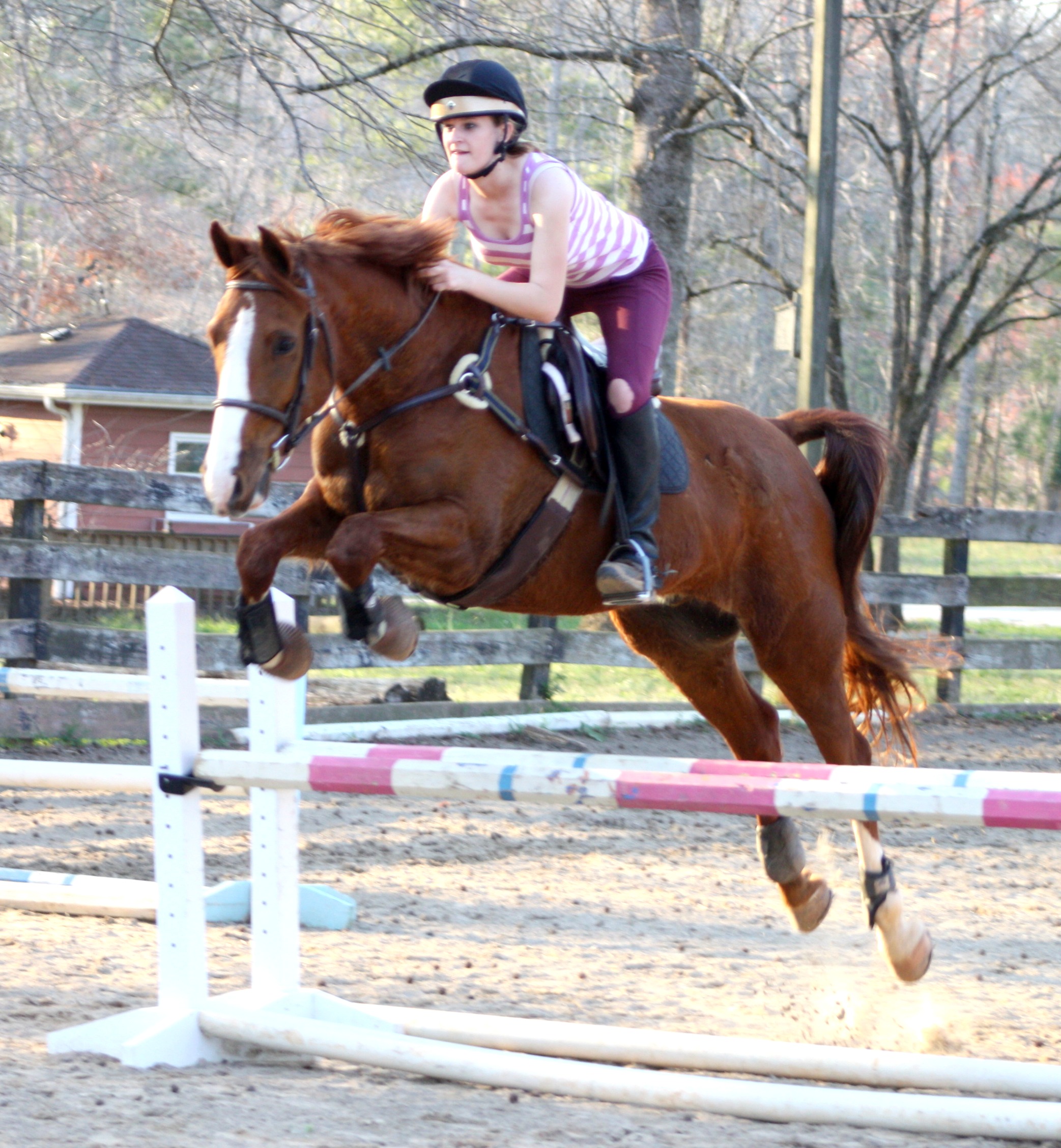
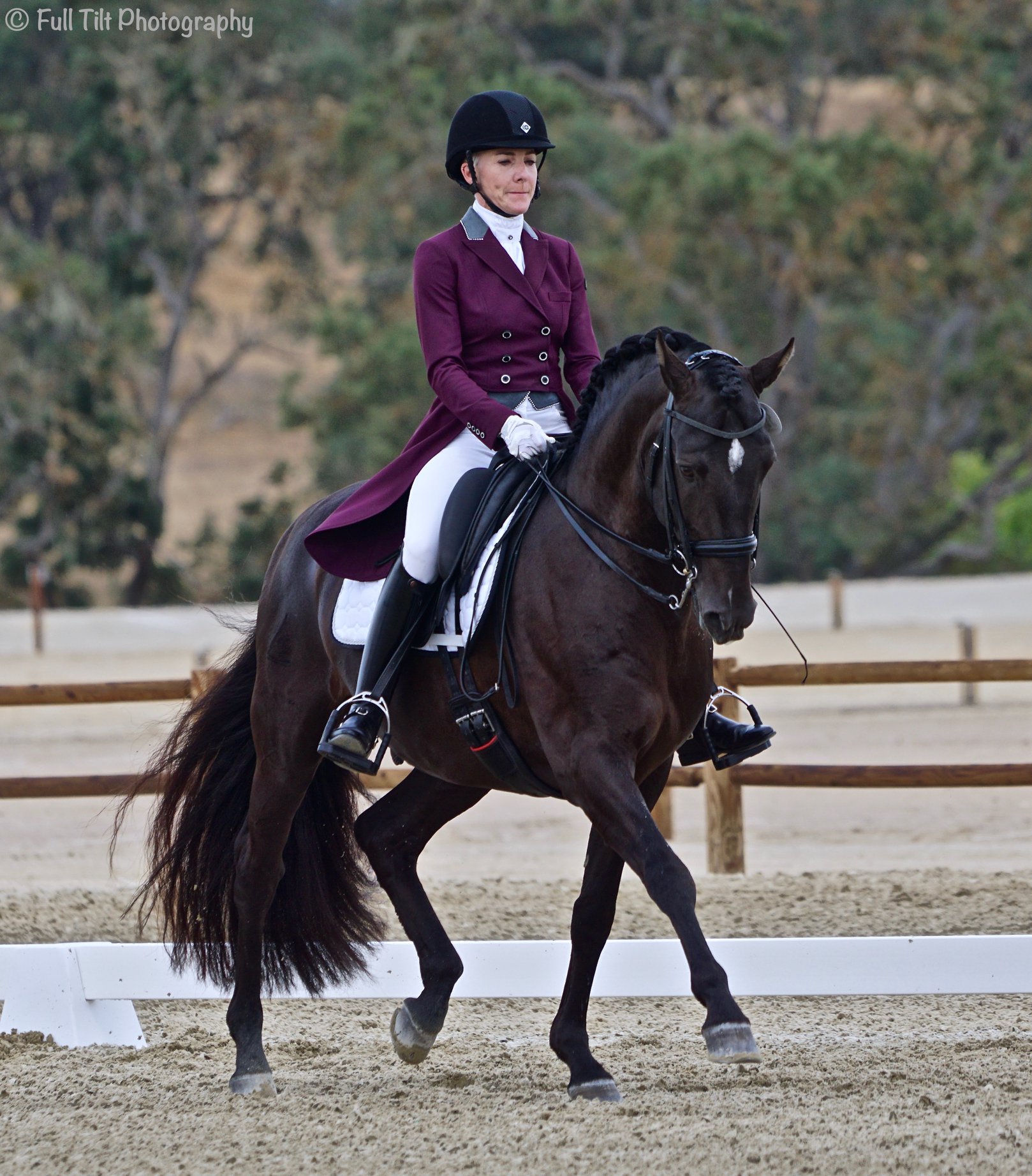
Photo #9: This is Cheryl's horse Winnie! Being ridden at a show by her trainer...
(Click on Photo Title above (in blue) to read critique)
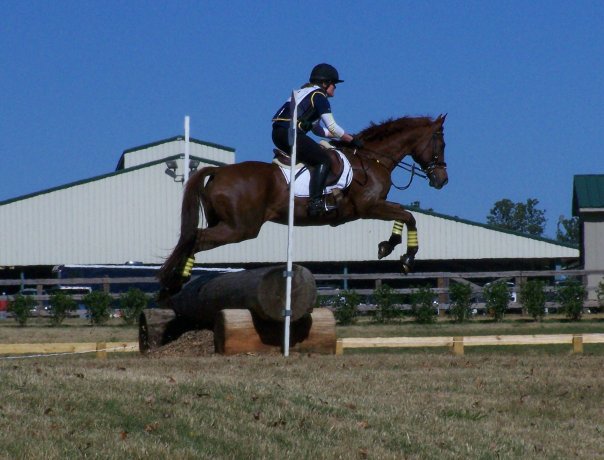
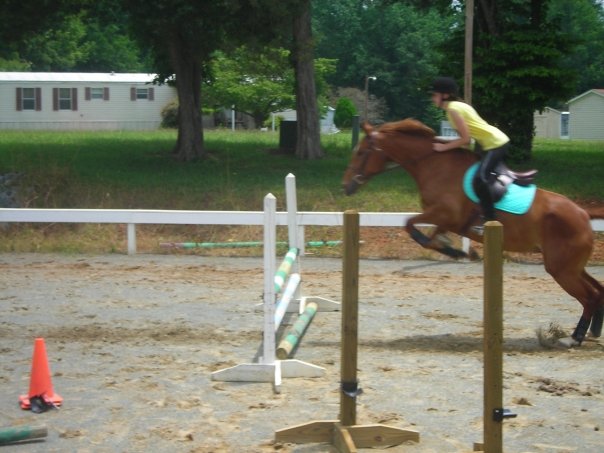
Narrow or skinny jumps have been increasingly showing up on cross country courses over the past 15 years or so. They started out only as an upper level test, and are now sneaking into the lower levels as well. They are a great test of whether the rider has the horse balanced, straight, and between their leg and hand. Course designers put skinny jumps on their courses to more safely test those qualities, as if the horse is not balanced, straight, or on the rider's aids, a runout is likely, but usually no one gets hurt.
As one moves up the levels in the sport of Eventing, the flatwork gets more and more exacting. At lower levels the horse's balance point is more forward, but at upper levels the horse should be in collection. Which means that the horse should be so balanced that they could literally canter on a balance beam. That is why the skinny jumps get narrower and narrower as you move up the levels. The upper level horse is expected to be accurate enough to gallop and jump on a balance beam.
How does one go about riding them successfully? (Click on Article Title above (in blue) to read full article)
Horses are the most amazing creatures....... from their awesome athletic abilities, to their regal spirit, to their generosity and desire to please us humans, to their fascinating powers of perception.
I feel like we owe it to them to carefully consider what we do with them on a daily basis. To make sure that our every interaction with them is fair and consistent, whether riding or handling on the ground. Here are a few key principles to follow: (Click on Article Title above (in blue) to read full article)
Balance in the saddle is a simple concept - but that doesn't mean it's necessarily easy to achieve. To be balanced on a horse a rider must follow this basic principle at all times: (Click on Article Title above to read full article)
What should you feel in your hands when your horse is going correctly on the flat? I think many riders are unsure of what they should be looking for.
What a rider feels in their hands is a direct correlation to the state of the horse's back and hindquarters. When a horse is straight, and carrying itself correctly - with forward energy flowing through a relaxed, swinging back into the connection of the bit, the rider feels....(Click on Article Title above (in blue) to read full article)
Throughout the world, horseman employ many different methods of conditioning the horse. And indeed there are quite a few different "programs" that result in a fit athlete. But most programs focus on the aspects of the horse's fitness that are the most visible - their musculature and their aerobic capacity (cardiovascular fitness) - without enough thought to strengthening bones, tendons, and ligaments. With a program that does not sufficiently allow for progressive strengthening of those important structures, the risk of injuries in those areas are greatly increased. The key is....(Click on Article Title above (in blue) to read full article)
(Photo credit to Jane Savoie - www.janesavoie.com)
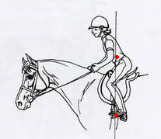
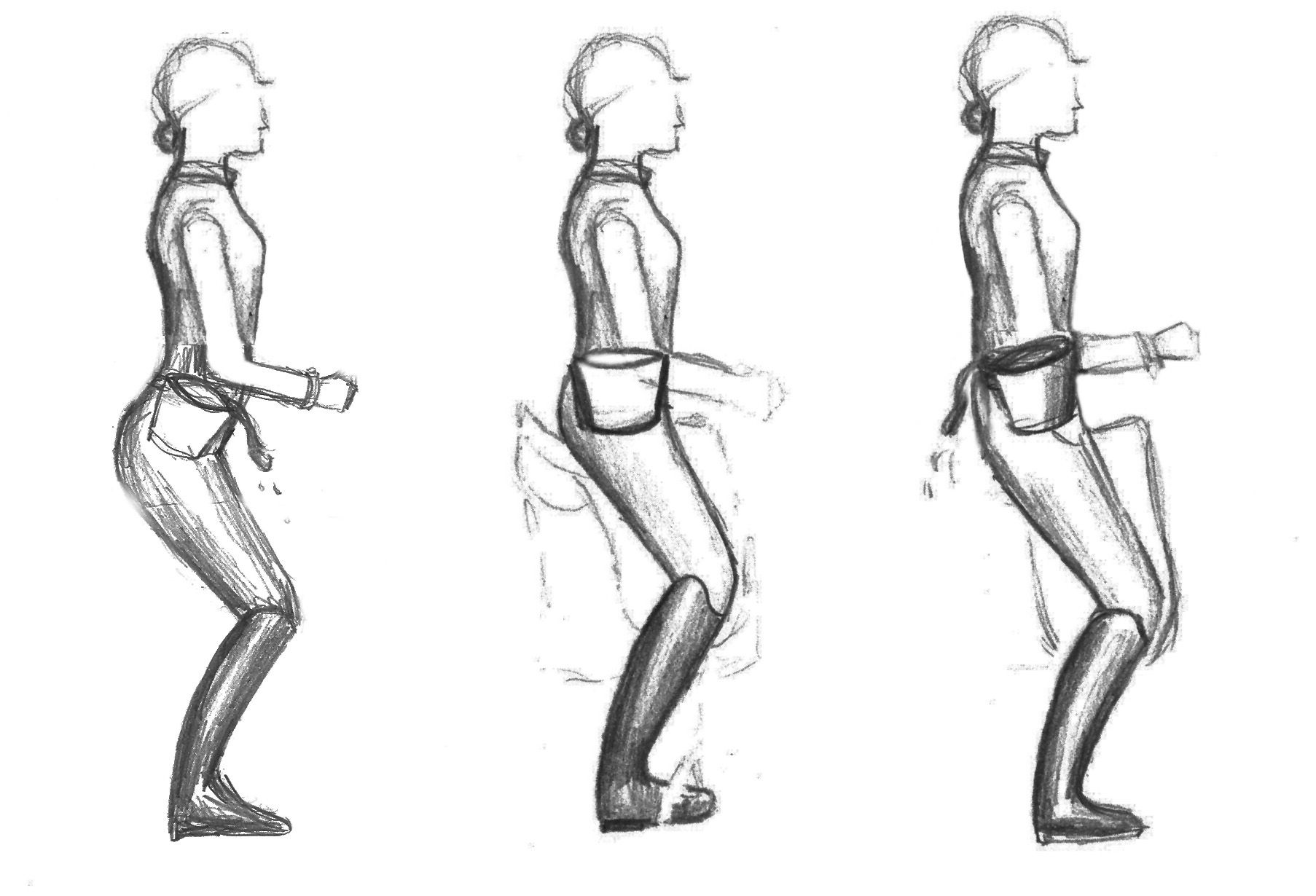
This drawing shows three different possible positions of the dressage rider's pelvis. The imaginary bucket of water in your pelvis should help you to see the effects of the different angles of the rider's pelvis. You can see how the change of the angle of the pelvis shifts the rider's center of gravity, and therefore tips the bucket... (Click on Article Title above (in blue) to read full article)
Stretching is a fabulous exercise for the horse, and should be done at the beginning and end of each workout, as well as intermittently throughout the ride for brief periods as a reward, and to test that your training has been correct.
I think that there are many riders who are slightly confused about what constitutes a proper stretch for the horse. I see many riders riding long and low, thinking that they are doing a constructive stretch, but are instead doing something quite unproductive. Riding the horse with it's head and neck low is only beneficial to the horse if there is a connection over the back. The following pictures show examples of right and wrong, and should help to clear up any confusion. (Click on Article Title above (in blue) to read full article)
There are 3 types of horses: those who can’t wait to see what’s around the next corner, those who are worried about what’s around the next corner, and those who don’t think about what’s around the next corner, and are surprised every time! A good event horse is usually the first one - curious and brave, with a good work ethic. There are of course many other attributes that make up a good event horse, but those are the ones who really come to love the sport. (Click on Article Title above (in blue) to read full article)
I could certainly answer you much more specifically if I could see a video of what is happening. Can you submit a video?
Generally a good, smooth, clean stadium round happens when you have the right quality of canter, and your horse is adjustable. Because it sounds like your horse is lacking in adjustability, the quality of your canter is diminishing as your round goes on, and you then are unable to fix it.
What do I mean by the right quality of the canter? The right canter to jump out of is balanced, rhythmic, straight, and in self carriage. With the appropriate amount of impulsion for the jump in front of you.
It takes adjustability to be able to maintain that canter throughout a course. Your horse may approach the first jump with the right canter, and land from the first jump running, flat, and out of balance. If your horse is adjustable, you can easily put him right back in the same quality canter you had before the jump. If you do not have adjustability, your rounds will get worse and worse like you describe.
My main focus is dressage and I have been riding almost daily for about two years but I am itching to try cross country. OK maybe not the big jumps and ditches. It's dead winter and I'm planning my spring and summer. Any suggestions on how I can get started in a small way and any advice to preparing my body. (Cheryl)
Hi Cheryl!
Yes, you should definitely give it a try! There is nothing like it. Nothing creates a stronger bond between horse and rider. That's when it's going well, of course!
I know I have to take it easy 'til he's 5, but how much can I do and what new exercises can I introduce to keep him from getting bored...? Thanks! (Jenny)
Hi Jenny!
My opinion is that little jumps are not really any harder on them than cantering. So as long as you don't overdo it, you should be fine to add a few jumps to his routine, maybe once or twice a week. At this age I like for them to understand that....(Click on Question title above (in blue) to read full answer)
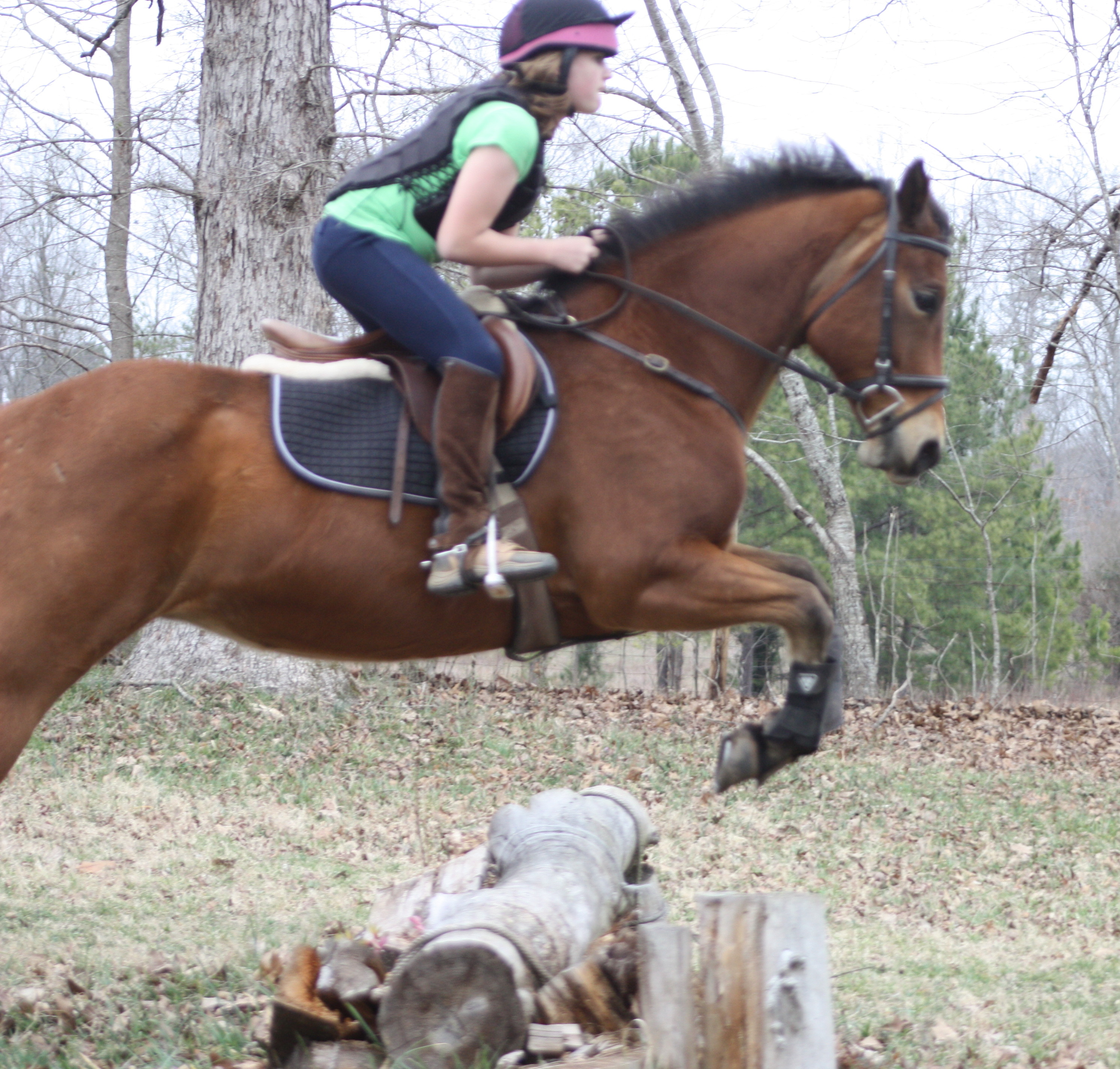
Photo # 3: This is Sarah!
(Click on Photo title above (in blue) to read critique)
I've never found any documented information on how cold is really too cold for the horse's lungs. But my cut off point has always been 15 degrees. Of course now that I live in the south, and have offically turned into a cold weather wimp, I rarely want to ride when it's below freezing! :)
My number one consideration when deciding if horses should be worked when it gets really cold is the footing. When the ground or arena footing is frozen I either don't ride or I mostly work in walk. The concussive forces on the horses' feet and legs are just too great when the ground is that hard. Now if you have some nice soft snow to ride in that changes things! Spray the bottoms of their feet with some cooking spray and have fun! Although that unfortunately doesn't work in all situations. I find in the south, whenever we do get snow, it's wet and icy. And the cooking spray does not seem to work to prevent the snoballs in their feet.
We are only doing flat work and light hacking at the moment, mostly getting the basics back, but I would really like to go to some competitions this year. Any suggestions on how to set goals for myself and my new horse? She has competed in a few unrecognized novice events, but it has been a couple of years and she was competed by a professional. (Cheryl)
Hi Cheryl!
Congratulations on your new horse!! I'm looking forward to watching you two become a team! Since she is new to you, and you both have been out of competition for a while, I would recommend that you really take the time to bond and get to know each other before you start competing. And it might be wise to ease into competition gradually by starting off with a dressage show or a schooling jumper show, instead of an event. That way you can see exactly what your new horse will be like away from home, and how she reacts to any show ring nerves that you may have. So pick one or two schooling type shows for late spring or early summer that may be a posibility. If you find that you don't feel ready as the dates get closer, that's no problem. Just skip those and look for something late summer or early fall. But I think that it really helps a rider to motivate themselves and ride with more focus, when they have some goals in the immediate future to strive for.
Here is a sample work week for the typical novice level horse: (Click on Question title above (in blue) to read full answer)
I think what started it was my giving him carrots while I saddled him so he wouldn't be so irritable about it. The first time he broke his halter he raised his head looking for a carrot. When he felt the pressure on his poll, he just kept pulling until he was free. I have stopped giving him carrots but today he did it again when I was brushing his ears-he raised his head and just kept going - as if once he started the process, he remembered the past episodes and got afraid and wanted to escape. I'd like to fix this quick! I know the Wrights only used break away halters on him and warned me about leaving him tied to the trailer when I took him to Lighten Up but he's never acted like this before. (Lisa)
Hi Lisa!
This problem stems from the fact that horses instinctively lean into pressure, and that they are naturally a bit claustrophobic. Not all horses can be completely cured of the "pulling back" problem, but many can be helped. So start by teaching him to "give" to pressure. (Click on the Question title above (in blue) to read the full answer)
I see there are "unrecognized trials" in MD, and I suppose that is the kind one starts at (also schooling days at some xc farms)! For instance, I've seen that certain things are required, helmet, vest, but what is a medical armband, and where does one get this?? I am going to join the USEA Area II, or do I join USEA? I am not interested in accruing points at this time. I just want access to information so I can get more knowledge and experience. (Andi)
Thank you for asking this question Andi, as I'm sure there are many others in the same boat as you are! It's hard to learn what you need to know, without already knowing what you need to learn about, isn't it?? The good news is that eventers as a rule are a very friendly and helpful, so don't hesitate to ask questions or ask for help while at your events. You will make lots of great friends in the process as well!
That said, you will feel most confident going into your first event if you are truly prepared for it, so here are some tips: (Click on Question title above (in blue) to read full answer)
Question #4: My name is Cheryl and I just bought a 7 yr old chestnut Irish Sport Horse Mare. Her name is Winnie and we've had probably 6 rides all together. The first 3 were absolutely wonderful and the last 2, not so much! During my last 2 rides she was much "higher" than my other rides (weather very chilly and windy) and we were hacking at a nice trot where she was exceedingly "speedier" seemingly with each step and before I knew it, she let out a big buck! It seemed like it came out of nowhere! She stopped after just one, and I stayed on, but my ride today was similar except that I couldn't even trot without feeling like she wanted to go faster and faster and got tight under the saddle. I could feel a buck just waiting to happen, so we went back to the basics, just walking calmly in the arena. Of course since I just spent a small fortune on her, I am a bit concerned and hope that I am not creating this problem by the way I ride? Any suggestions? Thank you Lesley and I look forward to hearing from you soon!!
Hi Cheryl!
Has anything changed in her routine? Now that you own her, is she still getting the same kind of food and the same amount that she was before? What about turnout? You may just need to lunge her a bit first on the cold windy days, especially if she has limited turnout.
I really can't make any comments on whether or not her tension is due to something you are doing without seeing a video. Can you get someone to video you?
I will make some general comments about helping a tense horse to relax, and maybe that will help you. (Click on Question title above (in blue) to read full answer)
Video #2: This is Andi and her horse Chester. Can you believe this horse is only 4 years old?? (Click on Video title above (in blue) to read critique)Question #3: My horse tends to get heavy on the forehand and leans on my hands a lot. What can I do to stop him from leaning on me and dragging me around?! (Anonymous)This is another very common problem. Your horse needs to learn to respond to half halts correctly to carry himself more instead of using your hands like a fifth leg to lean on. Here's my exercise to teach horse and rider the basis of a good half halt: (Click on Question title above (in blue) to read full answer) Photo #1:
This a great photo of Lauren and Jazz schooling over a Preliminary corner. (Click on Photo title above (in blue) to read critique)
5 and 6 bar competitions are so much fun to watch! Other than the obvious fact that the jumps are bigger, and therefore harder to jump cleanly - Can anyone tell me why this exercise of 5 verticals with a set distance between them gets more and more difficult as they raise the jumps?
What do you notice about how the whole line rides based on the quality of the jump they take at the first, smallest jump? And how can that be applied to your show jumping rounds?
Did you see any moments when a riders position was negatively affecting the horses ability to jump cleanly? (Click on Video Title above to read or join in on this educational discussion)
Question # 1: My horse tends to fall to the inside on circles and turns, especially to the right. What can I do to fix this? (Anonymous)This is a very common problem! And can be fixed by going back to the basics, and making sure the horse truly understands what the lateral aids mean. Once you know how to give lateral aids, and your horse understands what to do when you apply them, not only will you have the ability to fix the problem you mentioned, but you will have a solid foundation to build upon for more advanced work. Here's how to begin: (click on the Article Title to see full answer)
Newsletter Sign Up
Please fill in the details below to sign up to our newsletter.